ServicesEV Charger Installation
EV Charger Installation in River Oaks
We install Level 2 chargers and 240-volt outlets in garages and on outside walls. Before any work starts, we check what your panel can carry and walk you through the wire, breaker and mounting choices. You decide, and we tell you why each choice matters.
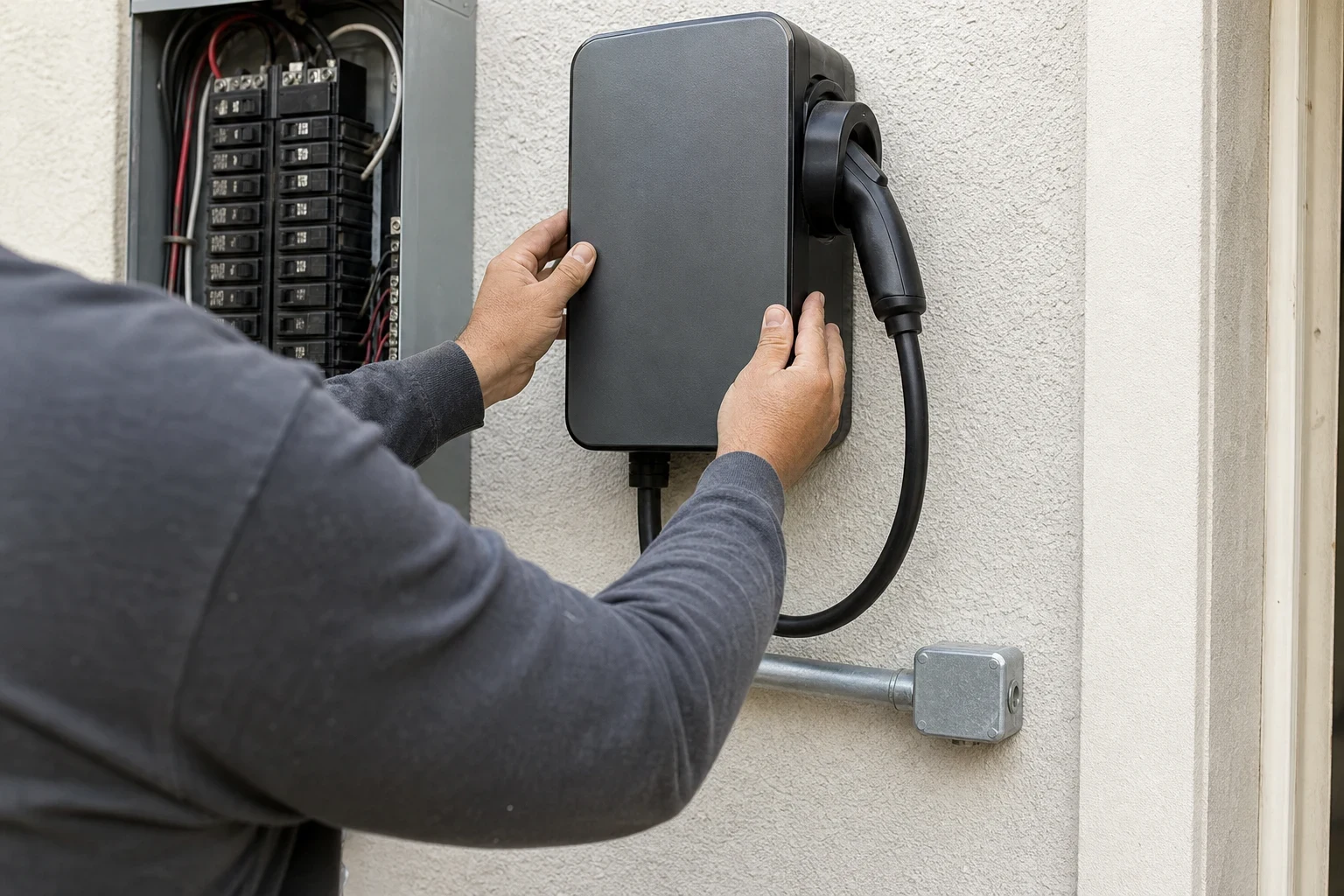
A Charger Circuit Built for Hours of Steady Load
An EV charger is not like a dryer or an oven. It can pull close to its full rating for six or eight hours at a time, night after night. Code treats that as a continuous load, so the circuit has to be sized at 125 percent of what the charger draws. A charger set to 40 amps needs a 50-amp circuit, plus wire and terminals that stay cool through all of it.
Most of the problems we see with home charging come from the parts behind the wall rather than the charger itself. Undersized wire runs warm. A budget receptacle loosens after a few months of plugging and unplugging. A panel with no spare room gets a breaker squeezed in where it doesn't belong. We choose each part for the load it will carry, and we tell you why.
Our licensed and insured electricians do the work, and a Master Electrical License stands behind every charger circuit we install.
What Your Charger Installation Covers
Checking the panel and load
We total up your home's current use and confirm whether the panel has the capacity and a free spot for a new 240-volt circuit. If not, we say so directly and walk through the options, such as a load-managed charger setting or a panel upgrade.
Hardwired charger or plug-in outlet
With a hardwired charger there's no plug to wear, and it can often charge at higher amperage. A NEMA 14-50 outlet means a portable charger can go with you when you move. We weigh that trade-off against your car and your driving.
Copper versus aluminum wire
Copper carries the same current in a smaller size and is easy on terminals, so it's our pick for most charger runs. On a long run to a detached garage, aluminum can be worth it, though it must be upsized and use terminals rated for it. When the distance warrants a comparison, we show you both.
Conduit and parts rated for outdoors
In the garage, EMT metal conduit shields the wire from knocks by bikes and tools. Outdoors, we use PVC or rated fittings with weatherproof boxes to keep sun and rain off the connections.
Heavy-duty industrial receptacle
If you choose an outlet, we put in a heavy-duty receptacle made for repeated use under load. Bargain 14-50 outlets often lead to melted plugs, and a better one costs only a little more.
Permit, load testing and cleanup
We take care of the permit and inspection your local jurisdiction requires, test the circuit under load, and sweep up drywall dust and wire scraps before leaving.
When a Dedicated Charger Circuit Makes Sense
The car isn't full by morning
When a regular 120-volt outlet can't put back a day's driving overnight, a Level 2 circuit usually can in a few hours.
A plug or outlet runs warm
Warmth at the cord end, the outlet face or an extension cord means the connection is under strain. Quit using it and get the circuit checked before you charge again.
The breaker trips while charging
When a charger shares a circuit with a freezer or garage tools, the breaker will eventually trip. Giving the charger its own circuit solves it.
You're expecting a new EV
With the circuit ready before the car arrives, you can charge at home from the first night instead of driving to public stations while you wait for an appointment.
The panel is full or aging
If there are no empty spaces in your panel or it's an older 100-amp service, get a load check before buying a charger so nothing catches you off guard.
How Your Installation Day Goes
- 1
Book the service visit
We start with a phone call to learn about your car, the charger you have in mind and where you park. Then we set a time to come out.
- 2
Look at the panel and the route
On site we check panel capacity, measure the run from the panel to the parking spot and look at walls, attic space and outside surfaces the wire will pass through. You'll get a clear scope with the material choices spelled out.
- 3
Install the circuit
We mount the breaker, run the wire in conduit or through walls and set the charger or outlet at a height that works for your cable. Most installs finish in a single day.
- 4
Test and show you how it works
We test the circuit under load, set the charger's amperage to match the breaker and show you any app or schedule settings. The inspection follows as required by the local jurisdiction.
What Moves the Price of a Charger Install
Every home is a little different, so we price after we've seen your panel and the route the wire has to take. The material choices you make are part of it too. We'll go over each line so you know what you're paying for.
- Distance from the panel
- A garage that shares a wall with the panel is a short, simple run. A detached garage or a driveway on the far side of the house needs more wire, more conduit and sometimes trenching.
- Charger amperage
- A higher-amperage charger needs a larger breaker and heavier wire. Many drivers do well with a 32- or 40-amp setup, and we'll talk through what your daily mileage really calls for.
- Panel capacity
- If your panel can't take the added load, a load-management device or a panel upgrade may be needed first. That's a separate decision, and we'll explain it before anything is ordered.
- Wall and finish conditions
- Running wire through finished drywall, brick or a hot attic takes more time than surface conduit in an open garage.
- Permit and inspection
- Permit fees and inspection steps depend on the local jurisdiction, and we include them in the scope so they don't show up later.
Common EV Charger Questions
Something not covered here? (682) 310-2319
Can my garage get an EV charger?
Yes, most of the chargers we put in go in garages. We first check the panel's capacity and how the wire will get there. For a detached garage, we find the best route, whether overhead, through the attic or buried.
Hardwired charger or NEMA 14-50 outlet: which should I choose?
Hardwiring means no plug to wear and often a faster charge rate. An outlet keeps things flexible if you switch chargers or move house. If you'll plug in and unplug every day, hardwired tends to last better.
Will you get the permit?
Yes. We take care of the permit and set up the inspection your home's local jurisdiction requires, so the paperwork isn't yours to handle.
Does a charger mean a new panel?
Not necessarily. Plenty of homes have space for a charger circuit, and many chargers can be turned down to a lower amperage or used with a load-management device instead of upgrading. If your panel really can't take it, we'll show you the reason and go over the choices.
Is there coverage once the job is done?
Yes. Every installation carries our 1-year workmanship warranty. The charger itself is covered by whatever warranty its maker offers.
Can the charger go on an outside wall by the driveway?
Yes. We use boxes rated for outdoors, weatherproof fittings and conduit that stands up to sun, and we position the unit so the cable reaches your charge port without stretching over a walkway.
Start Charging at Home
Let us know what you drive and where you park it. We'll book a visit, check your panel and go over the material options before anything is installed.