ServicesHome Battery Backup
Home Battery Backup for River Oaks Homes
When the grid goes down, a home battery keeps your refrigerator, lights, Wi-Fi and medical equipment on without fuel or engine noise. We go over the types of batteries, help you choose which circuits to cover, and install it so the handoff is clean and safe.
What a Battery Backup System Does for Your Home
A battery backup system stores electricity and hands it to your home the moment utility power fails. Most switchovers happen fast enough that clocks and computers never blink. Unlike a generator, there is nothing to refuel, nothing to start, and nothing running in the yard.
It is the right call when outages are short to moderate and you want silence, or when someone in your home depends on powered equipment. If you expect multi-day outages or want to run central air for long stretches, a standby generator may suit you better. We will tell you which fits, and our Generator Installation page covers that side.
Our electricians hold a Master Electrical License, and we size every system from your actual loads, not from a brochure.
What a Battery Installation Includes
- Sizing based on what you run
- First we list what you want powered and for how long. That gives us two numbers people often mix up: how much energy the battery holds, and how much power it can supply at one time.
- LFP versus NMC
- Most home batteries are built on lithium iron phosphate (LFP) or nickel manganese cobalt (NMC) cells. LFP is heavier for its capacity, but it tolerates heat better and typically lasts through more charge cycles. NMC packs more storage into less space. We compare them against your wall room and your garage temperature.
- Whole panel or chosen circuits
- You can back up the entire panel, or move only the circuits you pick, like the fridge, a few lights and the gas furnace blower, onto a critical-loads subpanel. Covering less lets a smaller battery run much longer.
- Gateway, transfer equipment and wire
- We install the gateway or transfer switch that separates your home from the grid when the power fails, so no electricity feeds back onto utility lines. Wire, breakers and disconnects match the battery's output.
- Permit, inspection and utility steps
- We file for the permit, schedule the inspection your local jurisdiction calls for, and coordinate with the utility when the process includes it.
- Turn-on and a tour of the controls
- We power the system up, set the charge it saves for outages, and walk you through the app or display so you can watch what it's doing.
Signs a Battery Backup Makes Sense for You
Outages keep catching you off guard
If storms knock your power out a few times a year and you lose food or work time, stored power covers those hours without you lifting a finger.
Someone relies on powered medical equipment
CPAP machines, oxygen concentrators and refrigerated medication cannot wait for the grid. A battery picks them up automatically.
A generator is not practical
Noise rules, tight side yards, or simply not wanting to store fuel can rule out a generator. A wall-mounted battery avoids all three.
You work from home
Keeping your router, modem and a workstation alive through an outage is one of the easiest loads a battery can carry.
Your panel is already full or aging
This is less a reason for a battery than a reason to look closely first. If your panel needs attention, we will tell you, and our Panel Upgrades page explains what that involves.
What Moves the Cost of a Battery System
Battery systems vary more in price than most electrical work, because the equipment itself is a big share of the total. We price each job after seeing your home and talking through what you want covered. Here is what makes the biggest difference.
Storage capacity and number of units
More hours of backup means more stored energy, which often means stacking a second or third battery. Trimming the backed-up circuits is the simplest way to keep this down.
Battery chemistry and brand
LFP and NMC units are priced differently, and brands differ in output power, warranty terms and expandability.
Whole-home versus critical loads
Backing up the full panel needs more output capacity and larger transfer equipment. A critical-loads subpanel adds wiring work but lets a smaller battery do the job.
Panel condition and placement
An older or full panel may need work before a battery can connect. Long wire runs from the battery location to the panel add material and labor.
How a Battery Install Unfolds
- 1
Site visit and location
We look over your panel, measure the available wall and pick a spot for the battery. That's often the garage or an outside wall, kept out of harsh afternoon sun that shortens battery life.
- 2
Written options
We put the battery type, storage size, backup layout and location on paper with the reason behind each pick. If two products would both serve you well, we list both.
- 3
Permit and scheduling
We file the permit and set an install date. Most homes lose power for only part of that day, while the transfer equipment is connected.
- 4
Installation
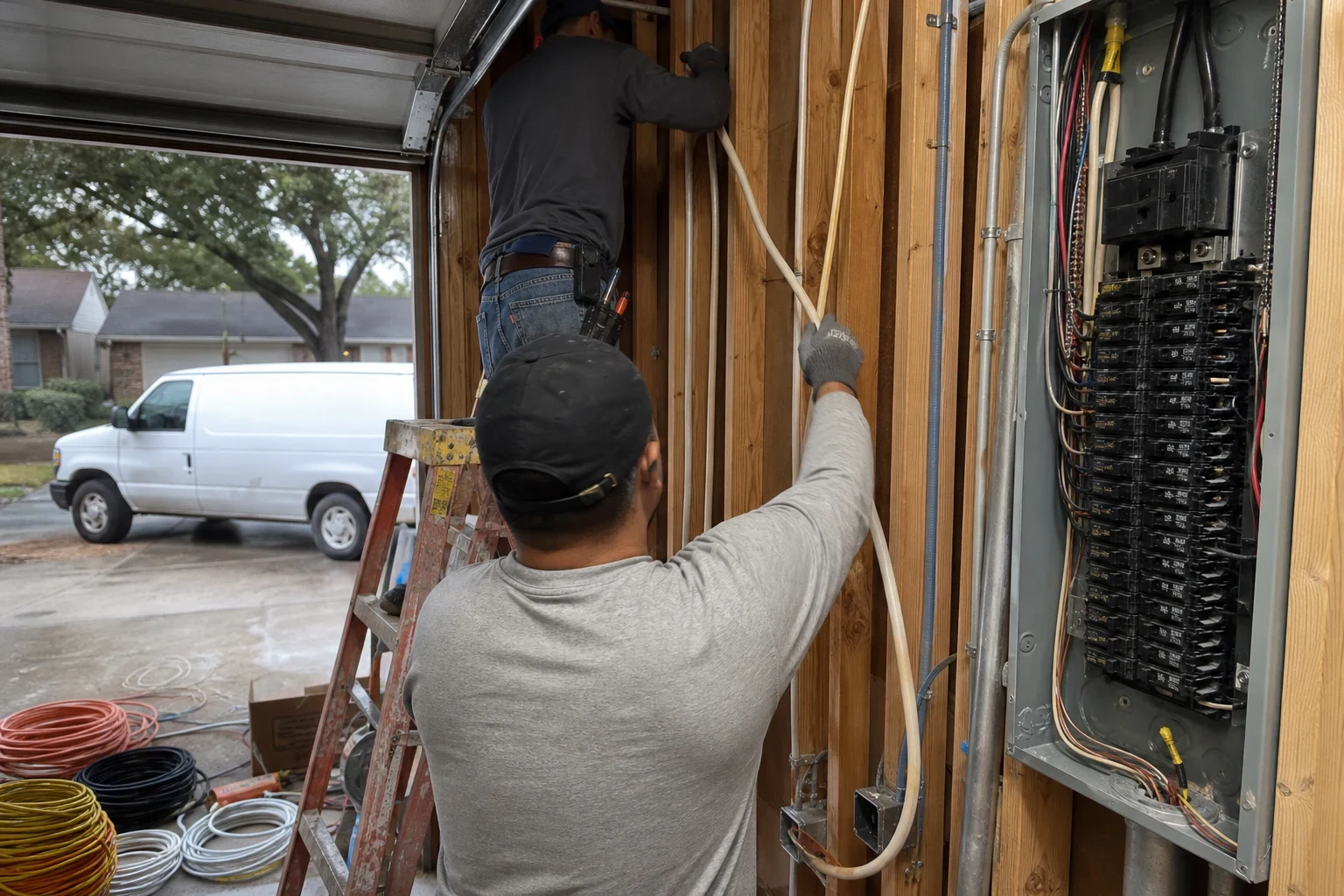
We mount the battery and gateway, run conduit and wire, add a subpanel when the plan calls for one, and protect floors and walls where we work. We clean everything up before leaving.
- 5
Inspection and hand-off
After the inspection passes, we simulate an outage with you watching, set your reserve level and explain the controls. A 1-year workmanship warranty covers our work.
Home Battery Questions We Get
How long can a battery run my home?
It comes down to what's plugged in. A single battery can usually keep a fridge, lights, internet and a few outlets going from evening to morning. Central air drains storage quickly, so we only plan for it if you want it. We estimate run time from your own circuits.
Which battery type does best in a hot Texas garage?
Heat is hard on every lithium battery. LFP handles high temperatures better than NMC, which is why we often suggest it for garages that get very hot in summer. We also mount units out of direct sun and away from the warmest wall when we can.
Can a battery connect to the panel I have now?
Often it can. During the visit we check your panel's capacity, condition and free spaces. If it needs work first, you hear why before you commit to anything.
Who handles the permit?
We do. The permit, the inspection your local jurisdiction requires and any utility steps are on us, so you don't have paperwork to chase.
What warranty covers the installation?
Our installation carries a 1-year workmanship warranty. The battery itself falls under the manufacturer's warranty, and we help you register it at handover.
Who does the installation at my house?
Licensed and insured electricians on our own staff. The crew that mounts the battery and wires the transfer equipment also runs the final outage test with you, so your questions go to the people who made the connections.
Talk Through Your Battery Options
Tell us what you want to keep running and we will come look at your panel and the spots where a battery could go. You will get the options explained in plain terms before any decision.